Proof of Heaven
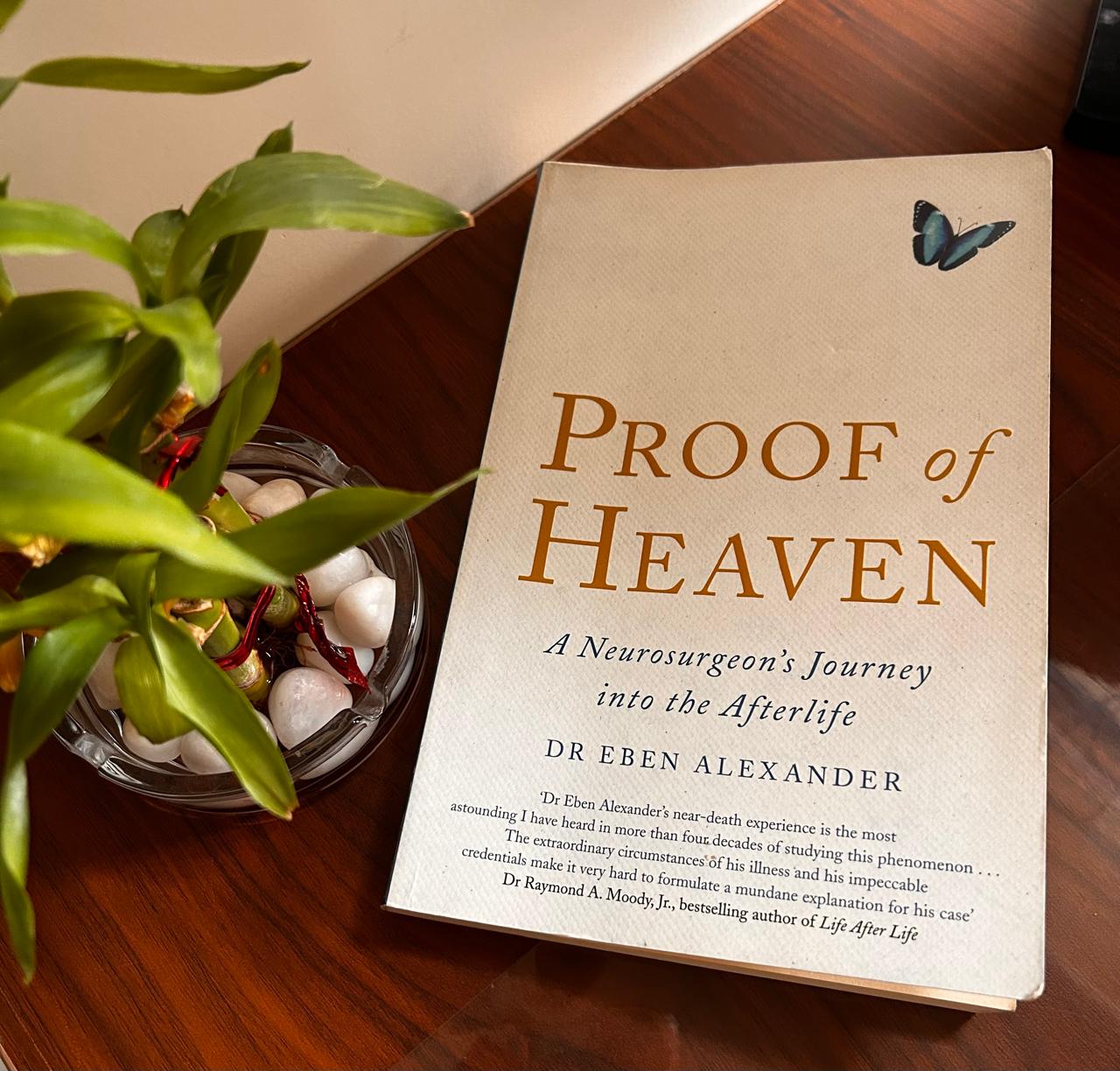
Proof of Heaven
By The Reading Room | Life, Reflection & Culture
I don’t remember exactly when I picked up Proof of Heaven — I think it was gifted to me — but I truly remember how it made me feel. Not unsettled, but curious to know more.
The book is written by Dr. Eben Alexander, a Harvard-trained neurosurgeon who spent his career operating on brains, teaching other doctors, and — by his own account — being fairly skeptical of anything resembling an afterlife. Then, in 2008, a rare bacterial meningitis put him into a coma for seven days. His neocortex, the part of the brain responsible for conscious thought, was effectively shut down. By every medical standard he’d spent decades relying on, he shouldn’t have had any experience at all during that week.
Instead, he says he had the most vivid experience of his life.
A doctor’s dilemma
What makes Proof of Heaven different from most near-death-experience books isn’t the experience itself — it’s who’s telling it. Alexander isn’t a mystic or a skeptic-turned-believer looking for an audience. He’s a man whose entire professional identity was built on understanding the brain as the source of consciousness. So when he woke up describing a world of impossible color, a guide he calls simply “the girl on the butterfly wing,” and a place beyond language he refers to as the Core — he had to reckon with the fact that his own science couldn’t explain what happened to him.
That tension is the heart of the book. He’s not asking you to believe him. He’s asking you to sit with the same discomfort he had to sit with: what do you do when your own expertise fails to explain your own experience?
What stayed with me
This book talks about an experience one may or may not believe, or even fully understand — and honestly, that doesn’t matter. What matters is that some of the truths within it undoubtedly bring peace and certainty.
“Nothing can tear us from God, ever”
There’s a moment in the book where Alexander describes being told, without words, that no matter what he had done or failed to do, he could never be separated from God. Not through doubt. Not through mistakes. Not even through death itself.
I sat with that line for a long time. So much of how we move through life is shaped by a quiet, background fear of disconnection — the fear that if we mess up badly enough, drift far enough, or doubt hard enough, we forfeit our right to whatever it is we believe in. Author pushes back on that fear directly. It suggests the connection isn’t something we earn or maintain through good behavior. It’s something that was never actually severable in the first place. We just forget that it’s there.
“Our truest, deepest self is completely free”
The second idea that stayed with me is closely related, but it hits differently: that our truest self isn’t crippled or compromised by our past actions, and isn’t tied to our identity or status either.
Read that again slowly, because it’s easy to skim past. Not tied to our past actions. Not tied to our identity or status.
That’s a genuinely radical claim if you let it be one. Most of us build our entire sense of self out of exactly those things — our history, our roles, our standing. To suggest there’s a “you” underneath all of that, fully intact and fully free, isn’t just comforting. It’s almost destabilizing, in a good way. It asks you to consider that the person you think you are might be smaller than the person you actually are.
“None of us are ever unloved”
The third line that stopped me was simpler than the first two, but somehow harder to sit with: none of us are ever unloved.
Not most of us. Not the people who’ve earned it, or behaved well, or held their lives together. All of us. No exceptions, no fine print.
I think this is the line that quietly undoes the first two, in the best way. It’s one thing to be told your connection to God can’t be severed, or that your truest self is untouched by your past. Those still leave a small door open for the mind to ask: but surely there’s a version of me bad enough to be the exception? The line about being unloved closes that door entirely. It doesn’t say “you are loved if.” It says you already are — categorically, without conditions, and apparently without ever having been otherwise.
What struck me is how quietly this contradicts the way most of us actually live. We treat love — from others, from God, from ourselves — as something to be earned through performance, apologized for through guilt, or lost through failure. The author suggests all three of those transactions are illusions. Not that they don’t feel real. They do. But that the underlying thing they’re all trying to protect or restore was never actually at risk in the first place.
On consciousness
The fourth, and perhaps most profound, idea the author talks about is consciousness itself. Before his NDE, he thought of consciousness the way most of the medical world does — as a matter produced by the brain, a byproduct of neurons firing. That view was completely upended after his experience.
He also brings up something philosophers and scientists call the “hard problem of consciousness” — the question of how, and why, physical processes in the brain give rise to subjective experience at all. Not just how a brain processes information, but why any of it feels like something to be you. It’s a question science still hasn’t solved, and remains a vast, unresolved subject on its own.
Why I’d recommend it, and why I’d push back a little too
This book is not a scientific literature — it talks about one doctor’s journey from a world of certainty into a bigger, unknown world. Somehow, it ends with a feel-good thought: that we are all acceptable, all lovable, to the Supreme God, and that the Almighty is always there with us.
This book is also a good reminder that the line between what we know and what we don’t is thinner than most of us like to admit.
Have you read it? I’d genuinely like to know what you took from it — reply in the comments, or find me on LinkedIn.