Indian Festivals — Unity in Diversity
Indian Festivals — Unity in Diversity
By The Reading Room / Culture & Festivals
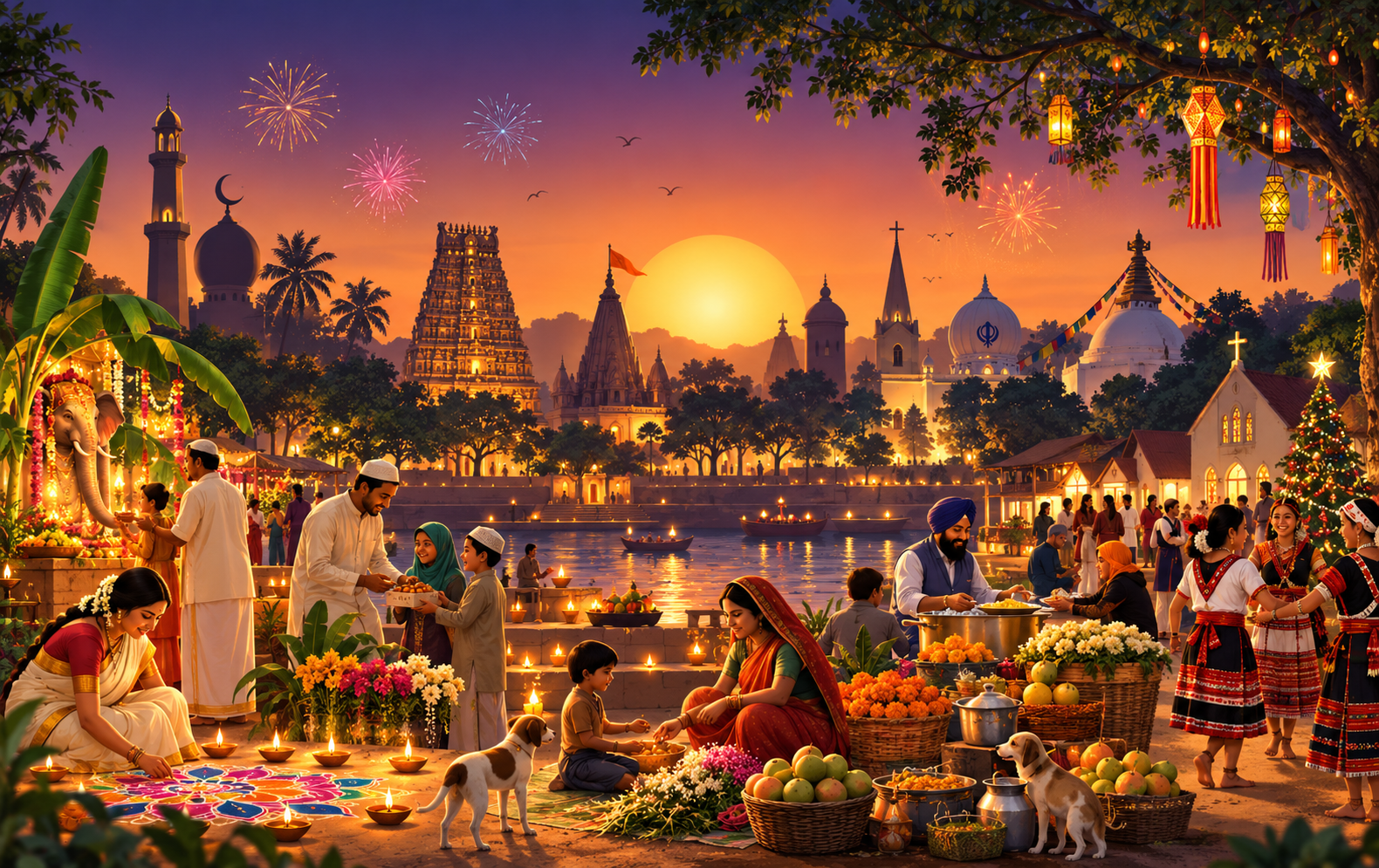
Every month of the Indian calendar celebrates a festival — starting from Makar Sankranti in January, through Holi, Baisakhi, Janmashtami, Navratri, Diwali, Christmas, Eid. There is rarely a month that passes quietly.
Most people call this diversity. It's really something simpler: a civilization that never needed one festival, one faith, or one story to hold itself together.
To understand why, it helps to go back more than a century, to a speech delivered nine thousand kilometres from home.
The Premise: A Civilization Built to Shelter Difference
In September 1893, a young monk from Bengal stood before the World's Parliament of Religions in Chicago and opened not with theology, but with a greeting: "Sisters and Brothers of America." The applause, by most accounts, lasted several minutes before he could continue.
Swami Vivekananda had not travelled across the world to argue that his faith was the correct one. In his Chicago Addresses, he made a different claim altogether — that the civilization he represented had built its identity not on conquest or conversion, but on the instinct to shelter belief systems different from its own. He pointed, as evidence, to communities that had found refuge on Indian soil for centuries after being displaced elsewhere.
It is worth sitting with that claim before going any further, because it reframes the entire question this article is asking. India's festivals are not a long list of separate religious observances that happen to occur in the same country. They are the visible surface of a civilization that was, by Vivekananda's own account, designed to hold multiplicity rather than resolve it.
The Foundation: One Root, Many Forms
If Vivekananda states the premise, Sri Aurobindo supplies the architecture behind it. In The Foundations of Indian Culture, written partly as a rebuttal to colonial dismissals of Indian civilization, Aurobindo argues that what looks from the outside like an unruly variety of practices, deities, and regional customs is, from within, the expression of a shared cultural and spiritual foundation — one that has simply chosen to speak in many different languages, regions, and forms rather than a single standardized one.
This is a useful lens for festivals specifically. A harvest festival in Punjab, a boat race in Kerala, and a lamp-lighting ritual in Gujarat can look, on paper, like unrelated regional customs. Aurobindo's argument is that they are better understood as regional dialects of the same underlying cultural grammar — variations on shared ideas about renewal, gratitude, light overcoming darkness, and the turning of the agricultural year. The festivals differ; the impulse behind them does not.
The History: How the Variety Accumulated
That still leaves an open question: how did this single cultural root come to express itself through so many distinct traditions, including ones that did not originate in India at all?
Jawaharlal Nehru's The Discovery of India, written in a prison cell in 1944, answers this with a historical rather than a philosophical argument. Nehru traces how successive waves of people, traders, and belief systems arrived on the subcontinent over thousands of years — and how, again and again, the pattern was absorption rather than erasure. New festivals did not replace old ones. They were added to the calendar alongside them.
This is the layer at which the specific names start to matter. Diwali and Ganesh Chaturthi did not simply coexist with Eid and Christmas by administrative accident — they arrived, took root, and were folded into a shared civic and social life alongside Baisakhi, Pongal, Onam, Gurpurab, and Buddha Purnima. Nehru's account gives this variety a timeline: it is not a modern compromise, but the outcome of a very long and largely voluntary process of cultural accumulation.
The Present: Why It Still Holds
The final piece of the arc brings the argument into the present day, where the stakes are no longer historical but political and social. Sunil Khilnani's The Idea of India examines how, after 1947, India's founders had to decide what would hold together a newly independent, staggeringly diverse population. Their answer, Khilnani argues, was not to flatten that diversity into a single national culture, but to build democratic and constitutional protections around religious tolerance and cultural pluralism as founding values in their own right.
This is why India's festival calendar today functions the way it does — not as a series of parallel, separate celebrations, but as a shared public rhythm. National holidays mark festivals from multiple faiths. Neighbours of different backgrounds visit each other's homes during Diwali and Eid alike. Local economies — artisans, decorators, sweet-makers, transport networks — depend on this calendar as a whole, not on any single festival within it. What began as a historical pattern of absorption became, after independence, a deliberately protected democratic value.
The claim, more than a century later
It is worth returning, at the end, to where this article began. Vivekananda closed his address in Chicago with a hope that the era of religious conflict was ending and one of harmony was beginning. More than a hundred years on, India's festival calendar is, in its own quiet and everyday way, still making his case for him — not through any single grand statement, but through the accumulated fact of millions of people, across faiths, lighting lamps, breaking fasts, decorating trees, and welcoming spring in the same shared year.
Perhaps that is what every festival really hands down: proof that we can be many, and still be one.
Further reading:
- Chicago Addresses — Swami Vivekananda
- The Foundations of Indian Culture — Sri Aurobindo
- The Discovery of India — Jawaharlal Nehru
- The Idea of India — Sunil Khilnani