Back to all articles
Book Lovers Day

Books That Shape Thinking — Book Lovers Day Edition
8 min readAugust 9, 2026
Books That Shape Thinking — Book Lovers Day Edition

Books That Shape Thinking — Book Lovers Day Edition

A Book Lovers Day celebration from The Reading Room


Book Lovers Day feels like the right moment to step back and ask a simple question: which books actually changed how you think?

Not the ones you enjoyed and forgot. Not the ones you recommend because everyone else does. The ones that left a permanent mark — the books you can trace a shift in your thinking back to, months or years after reading them.

We went through our shelf and picked nine. These aren't the most famous or the most celebrated. They're the ones that, for us, drew a line between how we thought before reading them and how we thought after. Each one shaped a different corner of the mind — from how we make decisions to how we understand people, from how we lead to how we see the world itself.

Here they are.


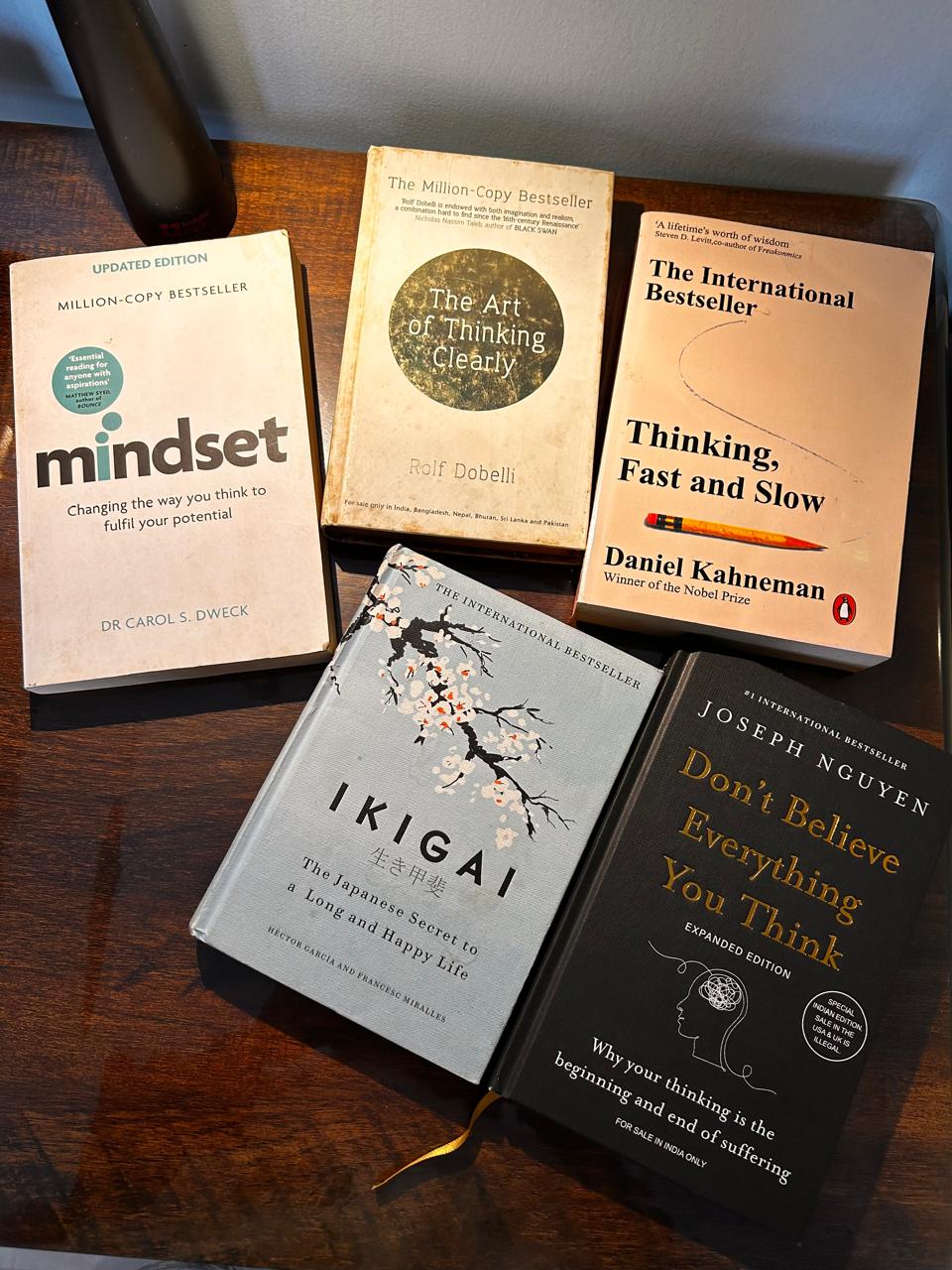
1. Thinking, Fast and Slow — Daniel Kahneman

The architecture of your own mind

Before this book, most of us assumed we were rational. After it, we knew we weren't — and we understood exactly why. Kahneman's distinction between System 1 (fast, intuitive) and System 2 (slow, deliberate) isn't just a theory. It's a mirror. Once you see the biases he describes — anchoring, loss aversion, the availability heuristic — you start catching yourself mid-thought, realising your brain took a shortcut you didn't authorise.

This is the book that makes you distrust your own certainty, in the best possible way.


2. Atomic Habits — James Clear

Small changes, remarkable results

The genius of Atomic Habits isn't the idea that habits matter — everyone knows that. It's the precision. Clear breaks down exactly how habits form (cue, craving, response, reward) and gives you a system so simple it almost feels too easy. The 1% improvement framework is now part of how millions of people think about personal change.

This book didn't just shape thinking — it shaped behaviour. And that's rarer than it sounds.


3. The Courage to Be Disliked — Ichiro Kishimi & Fumitake Koga

Freedom through Adlerian psychology

Written as a dialogue between a philosopher and a young man, this book introduces Alfred Adler's ideas in a way that feels like a conversation you might actually have at midnight with a wise friend. Its central claim is radical: all problems are interpersonal problems, and the key to freedom is separating your tasks from other people's tasks.

It's the kind of book that makes you uncomfortable in the first half and lighter in the second. The shift it produces is subtle but permanent — a quiet refusal to carry burdens that were never yours.


4. Sapiens — Yuval Noah Harari

The story of us, told honestly

Harari takes 70,000 years of human history and compresses it into a single, sweeping narrative that makes you see your own civilisation as if you were observing it from the outside. His argument that human cooperation is built on shared fictions — money, religion, nations, corporations — is the kind of idea that, once you hear it, restructures how you interpret the news, politics, and culture.

Sapiens doesn't tell you what to think. It changes the altitude from which you think.


5. The 7 Habits of Highly Effective People — Stephen R. Covey

Character before technique

Covey's framework — from dependence to independence to interdependence — is one of the most enduring models in personal development. But the real insight isn't the seven habits themselves. It's Covey's insistence that lasting effectiveness comes from character, not personality. In a world obsessed with hacks and shortcuts, this book quietly argues that there are no shortcuts worth taking.

Decades after publication, it still reads like it was written for today.


6. Proof of Heaven — Dr. Eben Alexander

When science meets the unexplainable

A Harvard neurosurgeon falls into a coma and has the most vivid experience of his life — one his own science cannot explain. What makes this book remarkable isn't whether you believe his account. It's the honesty of a man whose entire worldview was upended, and who chose to write about it knowing it would cost him credibility in the community he'd spent decades building.

This book shaped our thinking not by providing answers, but by widening the space for questions we hadn't dared to ask.


7. The Coming Wave — Mustafa Suleyman

The future is closer than you think

Suleyman, co-founder of DeepMind and CEO of Microsoft AI, writes about the approaching convergence of artificial intelligence and synthetic biology with a credibility most authors on this topic simply don't have. His central idea — containment — is both a warning and a framework: these technologies will transform everything, and the question is whether we can govern them before they outpace us.

This book reshaped how we think about technology, moving us from passive consumption of AI headlines to active, informed concern.


8. Ramakrishna As We Saw Him

Leadership through integrity

This is not a book of philosophy or doctrine. It is a collection of firsthand accounts — people describing, in their own words, what it was like to watch Sri Ramakrishna live out his teachings, day after day, at close range. What emerges is a portrait of a leader who earned trust not through authority or argument, but through relentless, visible integrity.

For us, this book reshaped how we think about influence. It suggested that the most powerful form of leadership isn't strategy — it's consistency between what you say and what you do.


9. Man's Search for Meaning — Viktor Frankl

Meaning in the darkest places

Frankl's account of surviving Auschwitz — and the psychological framework he built from that experience — remains one of the most profound books ever written. His central insight is deceptively simple: those who survived the camps were not always the strongest or the healthiest. They were the ones who found meaning, even in suffering.

"He who has a why to live can bear almost any how." That line alone has shaped how millions of people think about purpose, resilience, and what it means to endure.


Why these nine

We didn't pick these because they're bestsellers (though several are). We picked them because each one left us thinking differently — not for a day or a week, but permanently. A shift in how we make decisions. A new lens on history. A quieter, more honest relationship with our own minds.

That's what the best books do. They don't just inform you. They reshape the furniture inside your head, so quietly that you don't notice until one day you catch yourself thinking a thought you know you wouldn't have had before you read them.

Happy Book Lovers Day. Go read something that changes how you see.


Visit thereading-room.com for more reflections, curated reads, and honest conversations about the books that matter.

Tags: #BookLoversDay #BooksThatShapeThinking #TheReadingRoom #Reading #BooksToRead #ThinkingFastAndSlow #AtomicHabits #Sapiens #MansSearchForMeaning

Share this post:

Keep Reading