3 Books That Will Change the Way You Think
3 Books That Will Change the Way You Think
By The Reading Room | Mind & Psychology
Most of what we call "thinking" is actually reacting. We jump to conclusions, trust our gut, and rarely pause to ask whether our judgement is being quietly hijacked by bias, habit, or noise. These three books are the gold standard for anyone who wants to think more clearly, decide more wisely, and catch their own mind in the act of fooling them.
1. Thinking, Fast and Slow — Daniel Kahneman
The book that defined modern psychology of decision-making
If you read only one book on how the human mind actually works, it should be this one. Nobel Prize-winning psychologist Daniel Kahneman spent decades researching judgement and decision-making, much of it alongside his late collaborator Amos Tversky. The result is a book that has become a modern classic — a New York Times bestseller and winner of the National Academies Communication Award.
Kahneman's central idea is a distinction between two modes of thought: System 1 is fast, instinctive and emotional, while System 2 is slower, more deliberative, and more logical. Most of our daily decisions are made by System 1 — quick, automatic, and often wrong in predictable ways. The book summarizes decades of research to suggest that people have too much confidence in human judgement, and shows exactly where and why that confidence fails us.
What makes this book extraordinary is not just the theory — it is how often you catch yourself living out its examples in real time. Once you understand System 1 and System 2, you cannot unsee them in your own choices.
"Nothing in life is as important as you think it is while you are thinking about it."
Read this if: You want to understand the hidden architecture behind every decision you make.
2. The Art of Thinking Clearly — Rolf Dobelli
99 short, sharp lessons on the mistakes we make every day
This is quite a light book in comparison with the others — really a summary of 99 moves in thinking, some psychological, some logical, some social. Rolf Dobelli, a successful entrepreneur and writer, distilled decades of cognitive bias research into 99 short chapters, each just two to three pages long. It is the kind of book you can dip into rather than read from cover to cover — a book to keep going back to.
It's full of great tips on how to think more clearly, like how to avoid overthinking, how to stop procrastinating, and how to make better decisions, along with interesting facts about human psychology. Where Kahneman gives you the deep science, Dobelli gives you the practical field guide — a biases-spotting manual you can reach for whenever you sense your judgement might be off.
This is the book to hand to someone who wants the insights of behavioural psychology without committing to several hundred pages of academic detail. Short chapters, memorable examples, and an unpretentious voice make it endlessly re-readable.
"The first step in dealing with cognitive errors is to recognise them."
Read this if: You want bite-sized, practical lessons you can apply the same day you read them.
3. Think Straight — Darius Foroux
A short, no-nonsense guide to mental clarity
While Kahneman and Dobelli focus on bias, Darius Foroux's Think Straight tackles a different but equally important problem: mental clutter. This is a book for anyone whose mind feels like it has too many tabs open — overthinking, worrying, and looping without ever arriving anywhere useful.
Foroux makes a simple but powerful distinction: real thinking leads somewhere, while worrying just loops. He argues that you are not your thoughts — you are the one who chooses which thoughts to engage with. And perhaps most usefully, he reminds readers that clarity is not something you think your way into. It is something you act your way into.
This is the shortest of the three books and the easiest to finish in a single sitting — making it the perfect companion to the other two. Where Kahneman and Dobelli help you understand why your thinking goes wrong, Foroux helps you actually quiet the noise so you can think at all.
"You don't need to control your thoughts. You just need to stop letting them control you."
Read this if: Your mind feels cluttered and you need a clear, fast path back to focus.
Reading them together
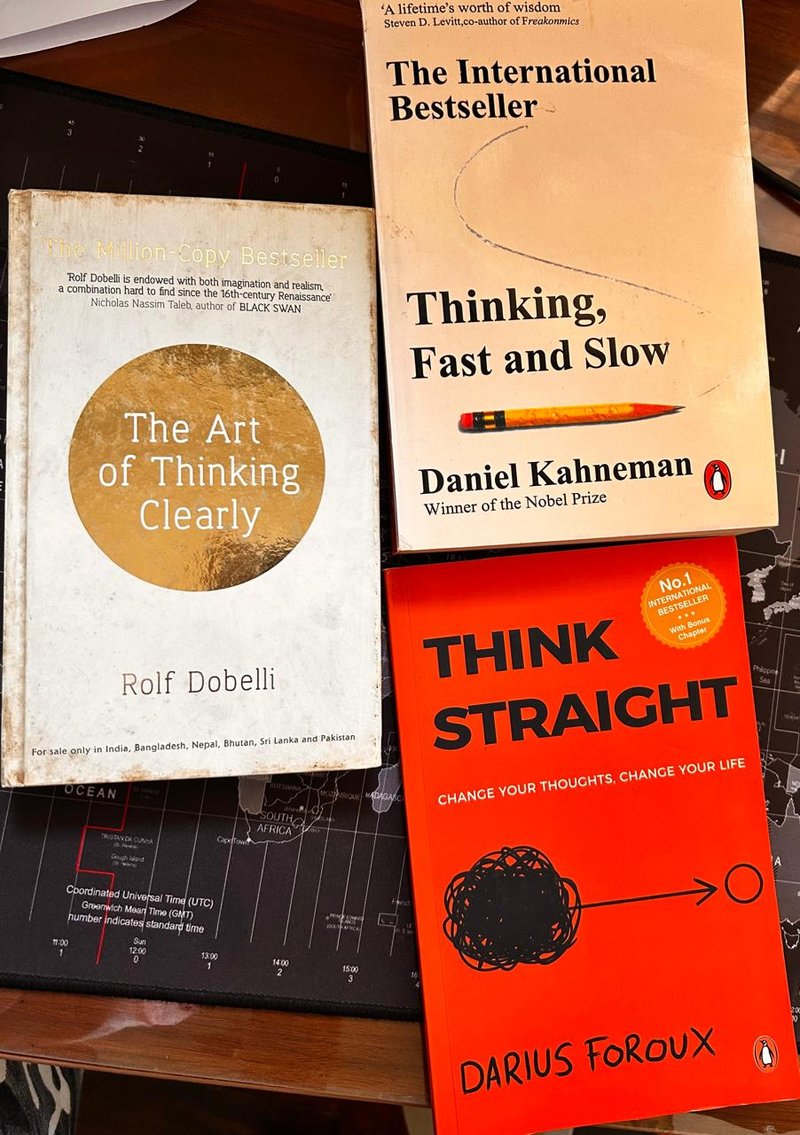
These three books work beautifully as a set, each tackling a different layer of how we think:
- Thinking, Fast and Slow explains the deep psychology — why your mind makes the errors it does
- The Art of Thinking Clearly gives you a practical catalogue of those errors, ready to spot in daily life
- Think Straight clears the mental noise so you have the calm and space to actually use what you've learned
If you are starting fresh, begin with Think Straight — it is short and immediately useful. Then move to The Art of Thinking Clearly for practical bias-spotting. Finish with Thinking, Fast and Slow once you are ready to go deep.
A final thought
We like to believe we think rationally, weigh evidence fairly, and arrive at conclusions through careful reasoning. These three books gently — and sometimes uncomfortably — prove otherwise. But that discomfort is the beginning of something valuable: a mind that questions itself, catches its own shortcuts, and makes room for clearer, calmer judgement.
That is what these books offer. Not perfect thinking — just clearer thinking. And that is more than enough.
Visit thereading-room.com for more curated book reviews and reading lists.
Tags: #BooksThatChangeHowYouThink #ThinkingFastAndSlow #CriticalThinking #DanielKahneman #RolfDobelli #DariusForoux #BooksToRead #SelfImprovement #TheReadingRoom #PsychologyBooks #MentalClarity